
Mist vs Foam Trigger Sprayers: A Buyer's Comparison Guide for Cleaning Products
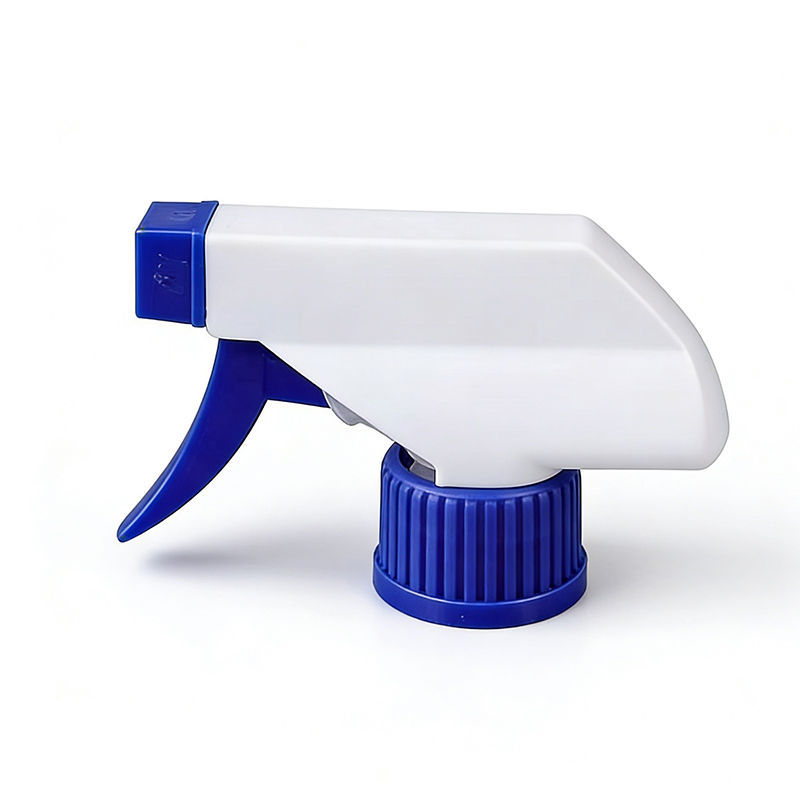 Mist-type PP trigger sprayer (ML-201B2) with single cover, one of the two output options buyers compare for cleaning products.
Choosing between a mist and a foam trigger sprayer is a spray-type decision that changes how a cleaning liquid leaves the bottle. Both configurations use the same manual trigger hand-press action, the same polypropylene (PP) construction, and the same 28/400 or 28/410 bottle neck fit; the difference is created inside the nozzle, where a mist version breaks the liquid into a fine, uniform spray and a foam version mixes air into the liquid to produce a stable foam.
For buyers in the evaluation stage, that single difference drives product behaviour. Mist output suits spray-and-wipe jobs such as glass and window cleaners, while foam output suits cleaners that have to cling to a vertical surface, such as bathroom and toilet cleaners, kitchen degreasers, and car care products. This guide compares the two spray types across output behaviour, material, thread compatibility, chemical resistance, and application fit, and maps them to the trigger sprayer range of Zhejiang Mila Plastic Industry Co.,Ltd., a trigger sprayer manufacturer based in Quzhou, Zhejiang, China, whose all-plastic and PP trigger sprayers are supplied with 28/400 and 28/410 closures.
Problem Definition: Why Spray Type Is a Locked-In Specification
Spray type is fixed earlier in a cleaning-product project than most buyers expect. Once the bottle, label artwork, formula, and front-of-pack claim are approved, moving from mist to foam (or the reverse) means a different internal nozzle or foam component, a re-test of the formula against the new output pattern, and a re-check of the claim printed on the pack.
Three risks make the mist-versus-foam decision expensive to reverse:
- Output versus formula mismatch. A formula built for foam depends on the way the liquid interacts with air inside the nozzle; the same liquid in a mist configuration behaves as a spray rather than a foam.
- Thread and closure mismatch. A sprayer built for a 28/400 bottle neck does not fit a 28/410 neck, even though both sizes are common in this category.
- Material compatibility. The sprayer body and internal parts stay in permanent contact with the cleaning liquid, so material selection has to be checked against the formula, not only against the bottle.
Getting the sequence right — cleaning job, formula, spray type, neck, cap, material — is cheaper than correcting a finished order after the tooling and packaging are already committed.
Industry Background: What Is Shaping Sprayer Selection
Trigger sprayer demand is steady rather than explosive. Fortune Business Insights values the global trigger sprayers market at USD 491.8 million in 2025 and projects a CAGR of 4.7% from 2026 to 2034. A second research house, Future Market Insights, projects 4.2% for 2026 to 2036; the difference is largely attributable to a broader scope that includes industrial dispensing systems, which is a useful reminder to check what a market figure actually covers before quoting it in a business case.
Two structural facts influence the mist-versus-foam decision more directly than market growth:
- Neck size standardisation. The 28/410 neck is identified as the most commonly used opening for trigger sprayers, which is why manufacturers such as MILA build the same sprayer platform to fit both 28/400 and 28/410 bottle necks.
- Packaging regulation. The EU Packaging and Packaging Waste Regulation (PPWR), adopted in April 2024, requires 30% recycled content in plastic packaging by 2030. Mono-material, all-plastic PP sprayer construction has therefore become a common evaluation point for buyers selling into Europe, because an assembly that is predominantly one polymer is easier to handle in packaging waste streams than a closure built from mixed materials.
For importers and brand owners, classification matters at the border as well: plastic closures of this type fall under HS code 392350 for stoppers, lids, caps, and other closures of plastics.
Mist Output vs Foam Output: The Core Technical Difference
Mist output: fine and uniform
A mist trigger sprayer breaks the liquid into small droplets and delivers them in a fine, uniform pattern across the target area. The deposit per pass is light, so the surface is wetted evenly rather than soaked. This is why mist versions are commonly matched to glass and window cleaners, light-duty surface sprays, and car interior or quick-detailer products, where an even film and a fast wipe matter more than dwell time.
Foam output: stable and clinging
A foam trigger sprayer mixes air into the liquid as it passes through the nozzle, producing a stable foam instead of a spray. The foam leaves a thicker deposit that stays on the surface longer and runs off more slowly, which is why foam versions are commonly matched to bathroom and toilet cleaners, kitchen degreasers, and car care products such as wheel cleaners, where the cleaner has to remain in contact with the soil to work.
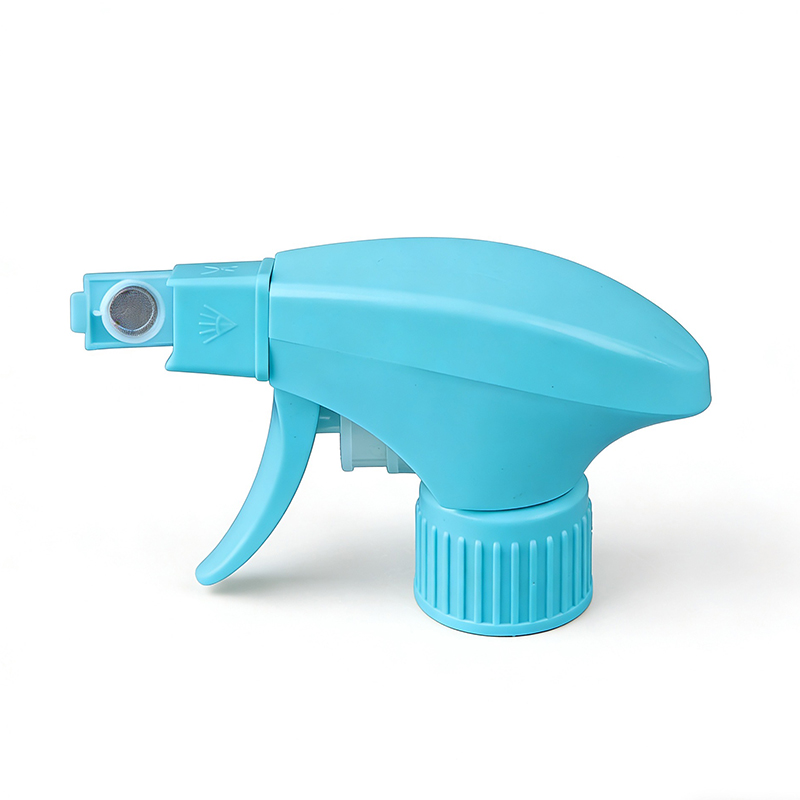 Foam-type all-plastic trigger sprayer (ML-102B1) with double cover, used where the cleaner has to cling to a vertical surface.
What both output types share
Mist and foam are two configurations of the same trigger sprayer platform, not two separate product families. In MILA's range they share the same closure type (trigger sprayer), the same PP material, the same manual trigger hand-press operation, and the same thread options (28/400 and 28/410), and they serve the same application list: household kitchen degreaser, bathroom and toilet cleaner, glass and window cleaner, and car care and auto detailing.
Platform Details: Manual Trigger, PP Material, and 28/400 or 28/410 Compatibility
Manual trigger hand-press operation
Both output types are operated in the same way: the user presses the trigger by hand and the pump mechanism draws liquid from the bottle. Because the action is manual, output consistency depends on the internal pump and nozzle design rather than on an external power source, and handling is identical whether the unit is configured for mist or foam.
PP construction and chemical resistance
MILA's trigger sprayers are built in PP, in an all-plastic range (ML-101G1, ML-101G2, ML-102B1, ML-102B2) and in a plastic PP range (ML-103C1, ML-201B1, ML-201B2, ML-202D1, ML-203H1, ML-204Z1). PP is widely selected for parts that stay in contact with cleaning chemicals, and MILA lists the chemical and daily-use chemical industry among the applicable industries for these models, alongside household cleaning, commercial cleaning and janitorial service, auto care and car detailing, and pet supplies. Chemical resistance is formulation-dependent, however: buyers should validate the final liquid — surfactant type, solvent or alcohol content, and pH — against the sprayer before committing to a full order.
28/400 and 28/410 thread compatibility
Every model in the range fits both 28/400 and 28/410 bottle necks, so one sprayer platform can serve two bottle specifications without a separate tooling decision. Because 28/410 is the most commonly used trigger sprayer opening, buyers who standardise on that neck can keep their bottle sourcing options open while using one sprayer design for both mist and foam variants of a product line.
Single cover and double cover options
Cover configuration is independent of spray type. Single cover models include ML-101G1 (foam) and ML-101G2 (mist); double cover models include ML-102B1 (foam) and ML-102B2 (mist). A brand can therefore keep one output choice and still differentiate packaging appearance across a product family.
Detailed Solution: MILA's Mist and Foam Trigger Sprayer Range
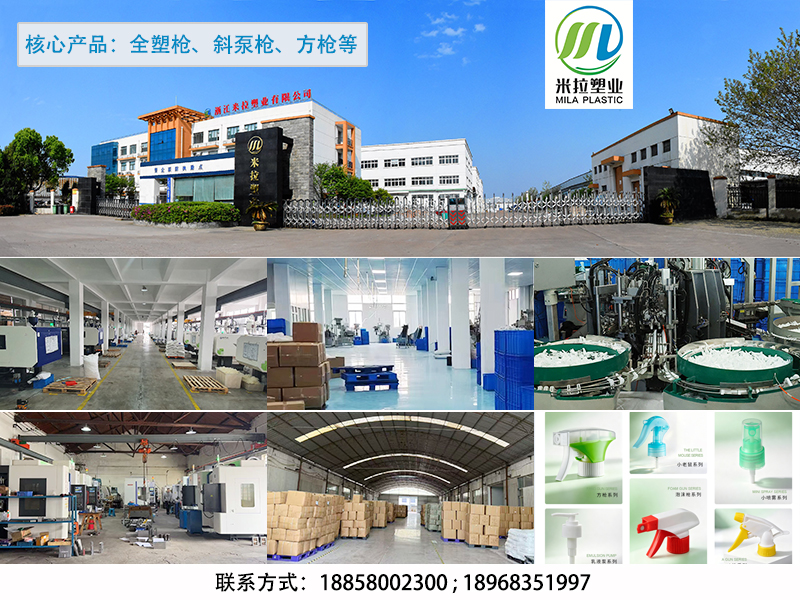
Zhejiang Mila Plastic Industry Co.,Ltd. was founded in 2018 and manufactures household care packaging from a factory covering more than 30,000 square meters in Quzhou, Zhejiang, with 300 to 400 employees, a 10-engineer R&D team, and an annual output of more than 600,000,000 pieces. Between 70% and 80% of production is exported, serving South America, Western Europe, Eastern Europe, East Asia, Southeast Asia, the Middle East, Africa, Oceania, and other markets.
The trigger sprayer range is organised around two output types and two thread sizes:
| Model | Category | Spray type | Material | Thread size |
|---|---|---|---|---|
| ML-101G1 | All-plastic trigger sprayer | Foam | All-plastic (PP) | 28/400, 28/410 |
| ML-101G2 | All-plastic trigger sprayer | Mist | All-plastic (PP) | 28/400, 28/410 |
| ML-102B1 | All-plastic trigger sprayer | Foam | All-plastic (PP) | 28/400, 28/410 |
| ML-102B2 | All-plastic trigger sprayer | Mist | All-plastic (PP) | 28/400, 28/410 |
| ML-103C1 | Plastic trigger sprayer | Mist | Plastic PP | 28/400, 28/410 |
| ML-201B1 | Plastic trigger sprayer | Foam | Plastic PP | 28/400, 28/410 |
| ML-201B2 | Plastic trigger sprayer | Mist | Plastic PP | 28/400, 28/410 |
| ML-202D1 | Plastic trigger sprayer | Foam | Plastic PP | 28/400, 28/410 |
| ML-203H1 | Plastic trigger sprayer | Foam | PP | 28/400, 28/410 |
| ML-204Z1 | Plastic trigger sprayer | Foam | Plastic PP | 28/400, 28/410 |
The design work behind the platform is protected by utility model patents granted by the China National Intellectual Property Administration, covering the all-plastic construction, locking functions, angle adjustment, and nozzle protection:
| Patent number | Scope | Issued | Valid until |
|---|---|---|---|
| ZL202321149508.9 | All-plastic trigger sprayer | 2023-11-28 | 2033-05-15 |
| ZL202321149516.3 | Lockable trigger sprayer | 2023-09-08 | 2033-05-15 |
| ZL202321038643.6 | Adjustable angle trigger sprayer | 2023-09-12 | 2033-05-05 |
| ZL202321038645.5 | Locking function trigger sprayer | 2023-11-28 | 2033-05-05 |
| ZL 202321349188.1 | Nozzle protection structure trigger sprayer | 2023-11-28 | 2033-05-31 |
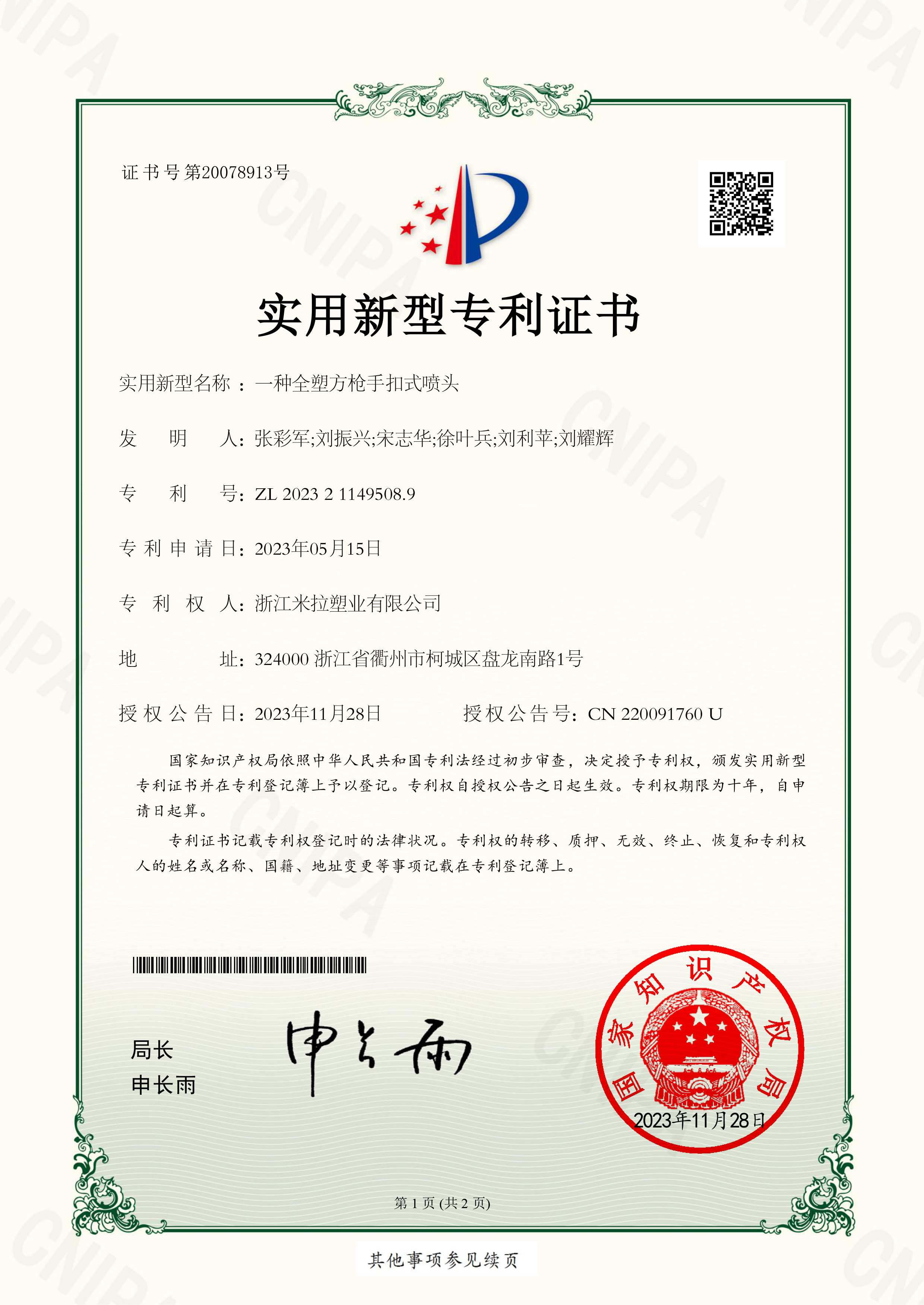 Utility model patent certificate ZL202321149508.9 for the all-plastic trigger sprayer, granted by the China National Intellectual Property Administration.
Production and quality control are set up for repeat bulk supply. MILA supports OEM and ODM production with a monthly capacity of 10,000,000 pieces, a typical production lead time of 7 days, and an MOQ requirement of 50,000 pieces per order for OEM and ODM production. Customisation covers colour, logo, and caliber. Quality control follows 100% test procedures on production output, and all products undergo 100% testing before shipment. If a large number of products in a batch have non-human quality problems, MILA supports returns or exchanges.
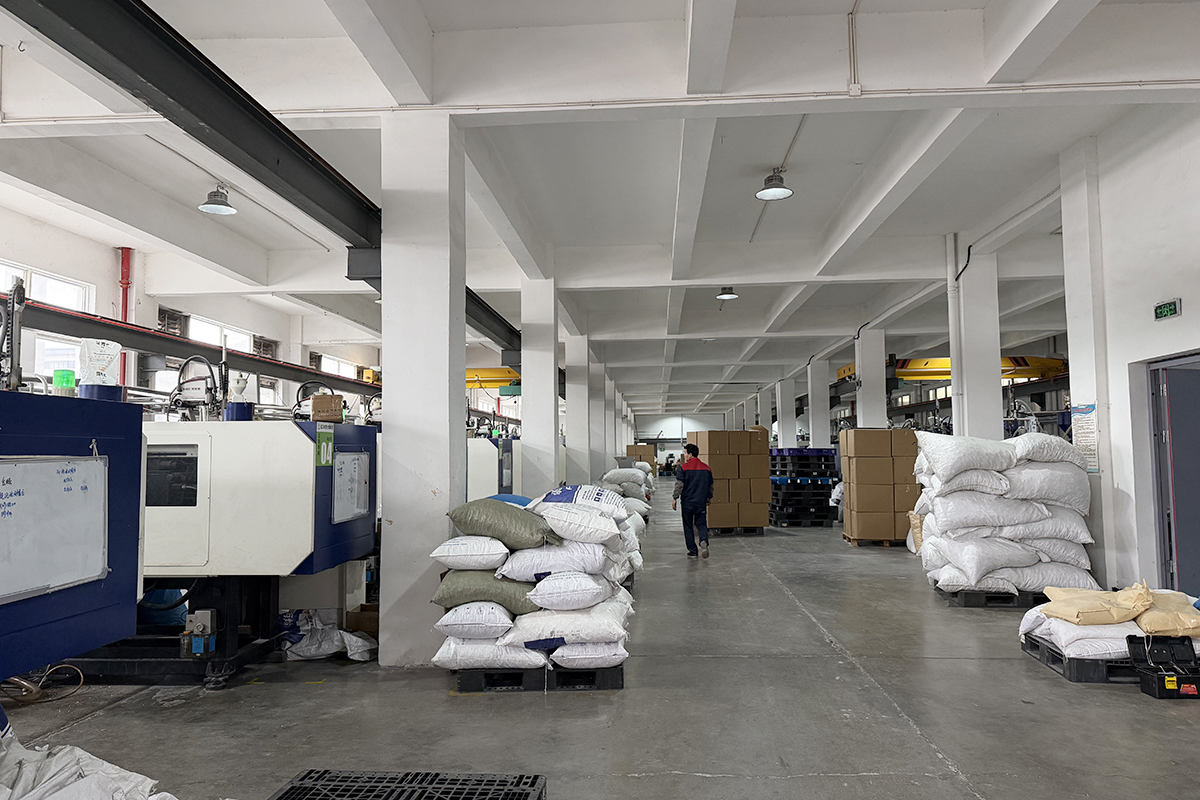 In-house injection molding capacity: the factory runs 60 injection molding machines and 20 automatic production lines.
Repeat supply is the pattern the factory plans for. In one programme, 5,000,000 pieces of trigger sprayers were supplied to a trading company and finished-goods packaging manufacturer in Egypt, serving the Middle East and Africa market. The project achieved stable product quality and satisfied customer feedback, resulting in repeated continuous orders, with reliable quality and stable supply capacity listed as the key highlights. The trigger sprayers used in that programme offer a reusable service life of 2–5 years, which supports long-term supply agreements rather than one-off purchases.
Step-by-Step Breakdown: How to Match Spray Type to a Cleaning Product
- Define the cleaning job first. If the product has to cling and dwell on a vertical surface, foam is the starting point. If it has to wet a surface evenly for a fast wipe, mist is the starting point.
- Check the formula. Surfactant level, viscosity, alcohol or solvent content, and pH determine whether a stable foam can be formed and how the liquid behaves inside a mist nozzle.
- Fix the spray type. Foam for bathroom and toilet cleaners, kitchen degreasers, and wheel cleaners; mist for glass and window cleaners, light-duty surface sprays, and car interior or quick-detailer products.
- Confirm the bottle neck. Select 28/400 or 28/410. The same MILA sprayer platform fits both, so this choice can be made after the bottle is chosen.
- Validate chemical compatibility. Confirm the PP body and internal parts against the finished formula, not only against water-based testing.
- Select the cover. Choose single cover or double cover to match the pack design; both mist and foam are available in either cover style within the ML-101 and ML-102 series.
- Sample and pilot-test. Run the assembled sprayer and bottle with the real liquid to check spray pattern, foam stability, leakage, and trigger feel before bulk production.
- Confirm the commercial terms. Verify MOQ (50,000 pieces per order for OEM/ODM), production lead time (typically 7 days), monthly capacity (10,000,000 pieces), customisation scope (colour, logo, caliber), and 100% testing before shipment.
Use Cases: Kitchen, Bathroom, Glass, and Car Care Products
Kitchen degreaser
Foam output is commonly used for kitchen degreasers, because the foam stays on hoods, tiles, and oven surfaces long enough for the surfactant system to work. Mist output is more often used for light kitchen surface sprays and sanitising steps where the liquid is wiped immediately.
Bathroom and toilet cleaner
Foam output is the typical match for toilet bowl cleaners and bathroom surface cleaners, where run-off down a vertical surface wastes product and reduces contact time. Mist output suits larger flat surfaces and shower screens that are sprayed and wiped in one pass.
Glass and window cleaner
Mist output is the standard choice. A fine, uniform spray applies a thin film that can be wiped without soaking the frame or leaving pooling marks, which is why foam is rarely used for glass cleaners.
Car care and auto detailing
Both types appear in this category. Mist is used for interior cleaners, quick detailers, and spray-on dressings; foam is used where the product must cling to a wheel, tyre, or panel before rinsing. MILA lists car care and auto detailing among the applicable industries for the full mist and foam range.
Comparison Table: Mist vs Foam Trigger Sprayers
| Comparison point | Mist trigger sprayer | Foam trigger sprayer |
|---|---|---|
| Output pattern | Fine, uniform spray of small droplets | Air-mixed liquid delivered as stable foam |
| Surface behaviour | Thin, even film; suited to spray-and-wipe | Thicker deposit that clings to vertical surfaces and runs off more slowly |
| Typical cleaning products | Glass and window cleaner, light surface sprays, car interior and quick detailers | Bathroom and toilet cleaner, kitchen degreaser, wheel cleaner |
| Trigger operation | Manual trigger hand-press | Manual trigger hand-press |
| Body material | PP; all-plastic models include ML-101G2 and ML-102B2 | PP; all-plastic models include ML-101G1 and ML-102B1 |
| Bottle neck fit | 28/400 and 28/410 | 28/400 and 28/410 |
| Outer cap options | Single cover (ML-101G2) or double cover (ML-102B2) | Single cover (ML-101G1) or double cover (ML-102B1) |
| Chemical exposure | PP construction; applicable to chemical and daily-use chemical industry, compatibility to be validated with the buyer's formula | PP construction; applicable to chemical and daily-use chemical industry, compatibility to be validated with the buyer's formula |
| Service life (programme data) | Reusable service life of 2–5 years (MEA programme data) | Reusable service life of 2–5 years (MEA programme data) |
| MOQ and lead time | 50,000 pcs per order for OEM/ODM; typical 7-day production lead time | 50,000 pcs per order for OEM/ODM; typical 7-day production lead time |
Decision rule: choose the output type from the cleaning job and formula first, then use cover style, colour, and logo customisation to differentiate the packaging. Reversing that order usually means reformulation or artwork changes later.
Frequently Asked Questions
Do mist and foam trigger sprayers meet packaging compliance requirements such as the EU PPWR?
Compliance starts with the regulation that applies to the packaging, not with the sprayer alone. The EU Packaging and Packaging Waste Regulation (PPWR), adopted in April 2024, requires 30% recycled content in plastic packaging by 2030. All-plastic PP sprayer construction supports mono-material packaging design, which is easier to handle in packaging waste streams than a mixed-material closure. Zhejiang Mila Plastic Industry Co.,Ltd. reports ISO 9001:2015 and ISO 14001:2015 certification and SGS compliance, and applies 100% test procedures on production output with all products tested before shipment. Because compliance also depends on the buyer's formula, label claims, and destination market, final confirmation should be made against the buyer's own regulatory checklist. Closures of this type are classified under HS code 392350.
Can the same trigger sprayer be supplied in both mist and foam versions?
Yes. Mist and foam are two output configurations built on the same trigger sprayer platform. MILA fits both 28/400 and 28/410 bottle necks across both types: the all-plastic range covers ML-101G1 and ML-102B1 in foam and ML-101G2 and ML-102B2 in mist, while the plastic PP range covers ML-201B1, ML-202D1, ML-203H1, and ML-204Z1 in foam and ML-103C1 and ML-201B2 in mist. All of them use a manual trigger hand-press action, PP material, and the same application list: household kitchen degreaser, bathroom and toilet cleaner, glass and window cleaner, and car care and auto detailing.
What is the minimum order quantity, and what drives the cost difference between mist and foam?
The MOQ requirement is 50,000 pieces per order for OEM and ODM production. Cost differences between a mist and a foam configuration come from the internal spray components and from the outer cap choice, since the range includes both single cover and double cover options. OEM and ODM customisation covers colour, logo, and caliber. Because price is quoted against the confirmed specification, a fair comparison between mist and foam keeps spray type, cover type, material grade, customisation, and order volume identical.
How should a buyer validate mist versus foam before mass production?
Validate with the actual liquid in the actual bottle, because output behaviour depends on the formula as much as on the sprayer. Buyers can request samples and a quotation for the mist and foam configurations they are evaluating, test spray pattern and foam stability with their own cleaner, and confirm the 28/400 or 28/410 neck fit on the bottle they intend to use. MILA supports OEM and ODM production and applies 100% test procedures on production output, with all products tested before shipment.
What is the production lead time for a mist or foam trigger sprayer order?
The typical production lead time is 7 days per production order, supported by a monthly capacity of 10,000,000 pieces. Spray type does not change the standard lead time; customisation (colour, logo, caliber) and order volume are the variables that affect scheduling. Long-term programmes are common in this category: a 5,000,000-piece project supplied to a trading company and finished-goods packaging manufacturer in Egypt developed into repeated continuous orders, and the trigger sprayers in that programme offer a reusable service life of 2–5 years. To discuss a mist or foam programme, send the target specification and volume to MILA Plastic Industry through www.triggerssprayer.com or WhatsApp +86 180-6742-7651.
Next Step: Compare Both Output Types on Your Own Formula
Mist and foam cannot be judged from a catalogue photo, because output depends on the liquid inside the bottle. Send your cleaner specification and target volume, and MILA Plastic Industry will quote the matching mist or foam configuration for your 28/400 or 28/410 bottle.
- Website: www.triggerssprayer.com
- Email: 18858002300@163.com / 18067427651@163.com
- WhatsApp, WeChat, Tel: +86 180-6742-7651 / +86 188-5800-2300
- Address: 1# Panlong South Road, Donggang Development Zone, Kecheng Area, Quzhou City, Zhejiang Province, China
Conclusion
The mist-versus-foam decision is driven by the cleaning job, not by the trigger. A mist trigger sprayer delivers a fine, uniform spray for glass and window cleaners, light surface sprays, and car interior products; a foam trigger sprayer delivers a stable foam that clings to vertical surfaces for bathroom and toilet cleaners, kitchen degreasers, and wheel cleaners. Both share a manual trigger hand-press action, PP construction, 28/400 and 28/410 thread compatibility, and single cover or double cover options, so a buyer can standardise on one platform and still offer both output types.
For evaluation-stage buyers, the practical sequence is: define the cleaning job, check the formula, fix the spray type, confirm the neck, validate chemical compatibility, then lock MOQ (50,000 pieces for OEM/ODM), lead time (typically 7 days), and quality control (100% testing) with the supplier.
Have Questions or Need More Details?
Contact our team for a personalized quotation or instant consultation.
Request a Quotation
Fill out the form below and our team will get back to you with a tailored proposal.
WhatsApp Direct Chat
Prefer to chat in real-time? Message us on WhatsApp for instant assistance & quick answers.
- Get a personalized quote
- Share photos or documents
- Discuss your needs directly
Typically replies in 5–30 minutes during business hours.