
Trigger Sprayer Technical Guide: Thread Fit, PP Body and Spray Mechanism
Three specifications decide whether a trigger sprayer performs on your filling line and on the shelf: the bottle neck thread fit (28/400 or 28/410), the body material and structure (PP, and whether the assembly is all-plastic and mono-material), and the spray mechanism (a manual trigger hand-press that delivers either a fine mist or a stable foam). This guide walks through each one in the order a buyer should verify it, using the MILA trigger sprayer range as a working reference.
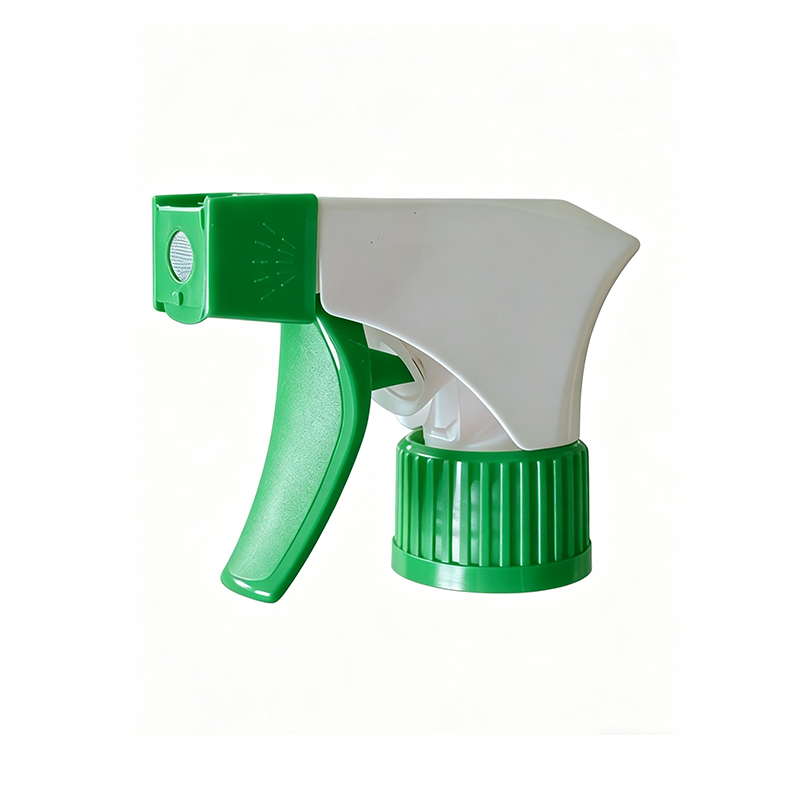
Why Trigger Sprayer Specifications Fail After the Order Is Placed
A trigger sprayer looks like a simple accessory, but it has to satisfy three independent interfaces at the same time: the bottle neck it screws onto, the chemistry it holds, and the user's hand and expectation of spray pattern. Failures rarely happen because a supplier is careless. They happen because one of those three interfaces was never written down in the purchase specification.
The recurring failure modes are consistent across the category:
- Thread mismatch. The closure was produced for one neck finish and the bottle arrives with another. The result is a loose fit, seepage at the shoulder, or a torque value that does not hold through shipping.
- Material mismatch. The closure is paired with an aggressive cleaning concentrate without confirming chemical resistance. PP covers a broad band of household chemistry, but compatibility depends on the specific formula, the dilution and the contact time.
- Spray mechanism mismatch. A fine mist sprayer is ordered for a foaming cleaner, or a foam sprayer for a glass cleaner. The trigger still works, but the product under-delivers at the point of use.
- Recycling mismatch. A buyer specifies recyclable packaging and receives a closure with a metal spring inside a plastic housing. The claim does not survive the recycling stream.
None of these differences are visible in a product photo. They appear in the specification sheet, the bottle neck drawing and the material declaration, which is why the three checks below are the practical starting point for any trigger sprayer order.
Industry Background: Three Signals Buyers Should Read Before Sourcing
Three structural signals explain why technical specification now sits at the front of trigger sprayer buying rather than at the end of it.
- Steady, non-dramatic growth. Fortune Business Insights values the global trigger sprayers market at USD 491.8 million in 2025 and projects a 4.7% CAGR from 2026 to 2034. Growth at this rate rewards repeatable specifications rather than one-off sourcing.
- A de facto neck standard. Houweling Group identifies 28/410 as the most commonly used opening for trigger sprayers. In practice this means most bottle moulds and filling lines are built around the 28 mm neck family, and a supplier that cannot offer both 28/400 and 28/410 variants adds friction to every project.
- Regulation on recycled content. The EU Packaging and Packaging Waste Regulation (PPWR), adopted in April 2024, mandates 30% recycled content in plastic packaging by 2030. Mono-material PP closures are structurally easier to fit into that requirement than multi-material assemblies.
One trade detail is also worth keeping on file: HS Code 392350 covers stoppers, lids, caps and other closures of plastics, which is the heading trigger sprayers are declared under. Buyers who keep the same classification across orders avoid customs and documentation surprises.
Check 1 — Thread Fit: 28/400 and 28/410 Bottle Neck Compatibility
The first number in a neck specification is the nominal opening diameter; 28/400 and 28/410 both describe a 28 mm neck. The second number describes the thread finish — the profile and height of the thread itself. Because the finishes differ, a closure engineered for one finish does not automatically seal correctly on the other, even though the two bottles look identical on a filling line.
In the MILA range, trigger sprayers are supplied with thread size options of 28/400 and 28/410, and the models are compatible with 28/400 and 28/410 bottle necks. That dual compatibility applies across the technical models used as examples in this guide, including ML-102B1, ML-102B2, ML-202D1, ML-203H1 and ML-204Z1.
What to verify before confirming the order
- Ask the bottle supplier for the neck drawing, not a bottle photograph. The finish specification lives in the drawing.
- Confirm whether the closure is engineered for the finish your bottle uses, and whether it is dual-compatible with both 28/400 and 28/410.
- Check sealing at the torque your filling line applies, and re-check after a resting period to catch slow seepage.
- Confirm leak-proof performance where the product is a low-viscosity liquid. In MILA application data for these sprayers, chemical resistance, leak-proof performance and plastic construction are listed as the special requirements for household cleaning, commercial cleaning, car care and daily chemical packaging projects.
Practical rule: confirm the neck finish before you confirm the colour. Colour is reversible; a thread finish is not.
Check 2 — PP Body: Single Material, All-Plastic Structure and Recycling
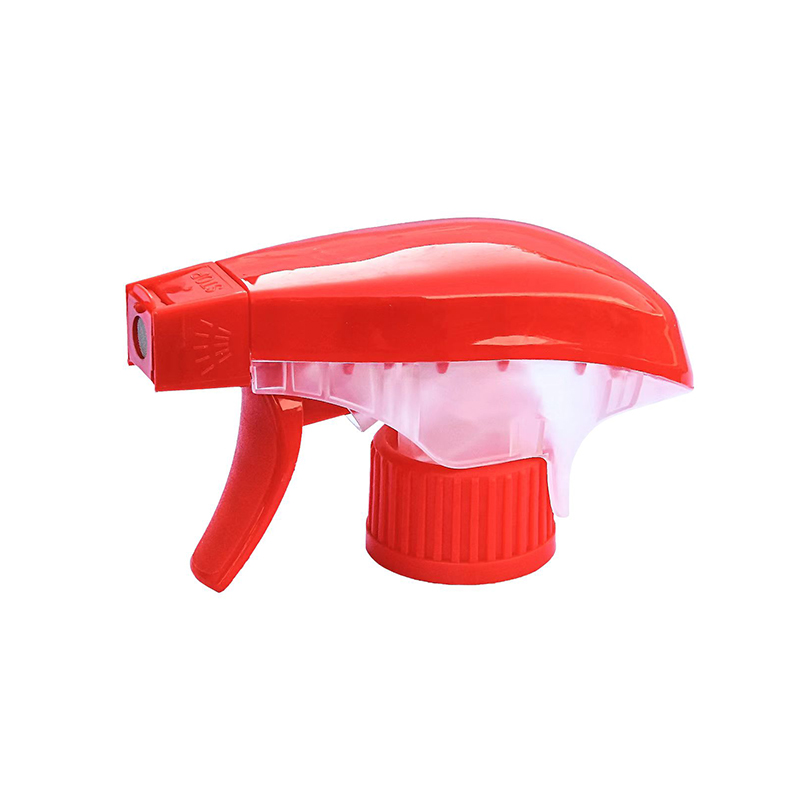
PP, polypropylene, is the primary material of the MILA trigger sprayer range. That choice determines two things buyers care about commercially: how the closure behaves against cleaning agents, and what happens to it at end of life.
All-plastic and mono-material construction
The models ML-101G1, ML-101G2, ML-102B1 and ML-102B2 are all-plastic trigger sprayers with a full-plastic structure without a metal spring, made of a single material (PP) which is recyclable. ML-102B1 and ML-102B2 use a double cover outer cap, while ML-101G1 and ML-101G2 use a single cover.
The distinction is not cosmetic. In a conventional assembly with an internal metal spring, the spring has to be separated before the plastic can be reprocessed — exactly the handling step that EU PPWR recycled-content targets are designed to reduce. A mono-material PP closure removes that step and keeps the component in a single polymer stream.
Chemical resistance and its limits
PP construction provides chemical resistance to a range of cleaning agents, and the working conditions recorded for these sprayers include chemical resistance, normal temperature operation, indoor and outdoor use, and corrosion resistance. Matched equipment for the same projects is a plastic bottle or a chemical packaging bottle.
One honest limitation deserves a place in the specification: PP is not a universal answer for every chemistry. Where a formula uses aggressive solvents, very high active concentrations or long contact times, compatibility should be verified against the actual concentrate and the actual bottle before a bulk order is released. A sample test on production packaging is the fastest route to that confirmation.
Check 3 — Spray Mechanism: Manual Hand-Press Control, Mist vs Foam
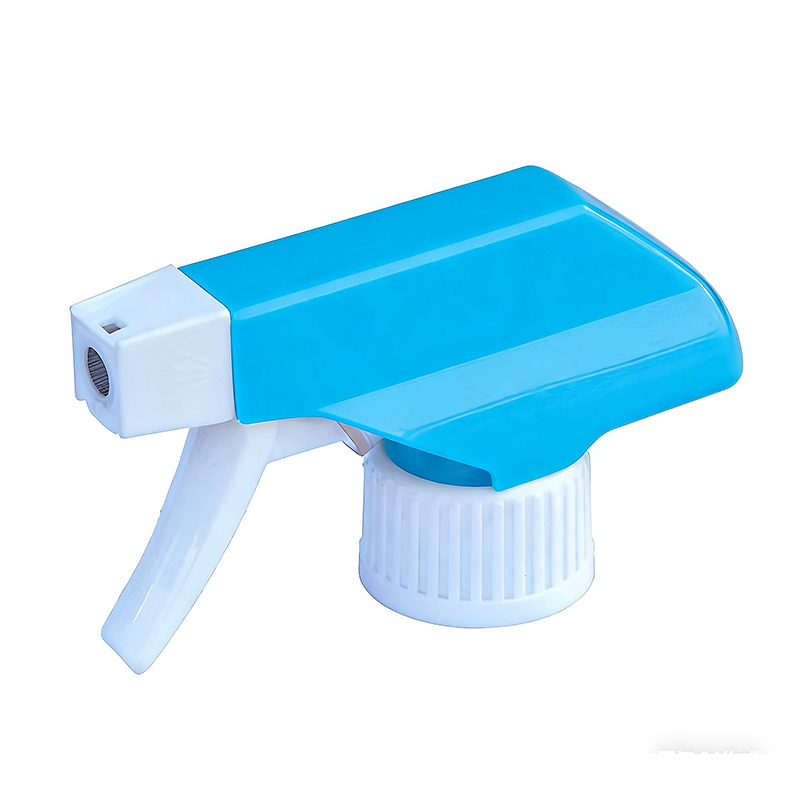
Every model in the range uses a manual trigger hand-press operating mode: the pump is actuated by the user's hand, and the control method is trigger-actuated manual dispensing. There is no aerosol propellant and no powered component, which simplifies transport, storage and end-of-life handling. ML-201B1 uses an inclined pump design.
What separates the models is the spray output.
- Mist spray. Models ML-101G2, ML-102B2, ML-201B2 and ML-103C1 produce a fine and uniform mist output.
- Foam spray. Models ML-101G1, ML-102B1, ML-201B1, ML-202D1, ML-203H1 and ML-204Z1 produce a stable, rich and uniform foam output. The foam spray type is applied with foaming cleaner formulas used in household cleaning products.
The trigger hand-press design is specified for comfortable hand-press operation, which matters for products that are used in repeated short bursts rather than a single long spray.
Decision rules that shorten the selection process
- If the formula is designed to foam on contact, specify a foam spray type.
- If the product should wet a surface as a thin, even film, specify a fine mist.
- If one bottle line will carry both variants, keep thread size and dip tube dimensions common so only the sprayer changes.
- If recyclability is part of the brief, pair an all-plastic mono-material model with your spray type requirement rather than treating the two decisions separately.

Step-by-Step: What to Verify Before You Place a Bulk Order
- Lock the neck finish. Obtain the bottle neck drawing and confirm whether the project uses 28/400 or 28/410, or a dual-compatible closure.
- Select the material and structure. PP body as standard; all-plastic mono-material construction where recyclability is part of the packaging brief.
- Select the spray type. Mist or foam, matched to the formulation rather than to the product name.
- Confirm the outer cap configuration. Single cover on ML-101G1 and ML-101G2, double cover on ML-102B1 and ML-102B2, depending on brand presentation.
- Confirm the customization scope. Bulk orders and OEM customized colour are supported across the range.
- Test on the production bottle. Validate fit, leakage and spray output using the actual bottle and the actual formula, not a generic laboratory bottle.
- Collect the documentation. Confirm certification and trade classification, including HS Code 392350.
Documentation check: Zhejiang Mila Plastic Industry Co.,Ltd. holds ISO 9001:2015 and ISO 14001:2015 certification and SGS compliance, which supports quality and environmental claims made in a packaging specification.
Use Cases: Which Configuration Fits Which Product
The sprayer range is intended for the household cleaning industry, commercial cleaning and janitorial service, the auto care and car detailing industry, the pet supplies industry, and the chemical and daily-use chemical industry. The typical application scenarios named in the product data are household kitchen degreaser, bathroom and toilet cleaner, glass and window cleaner, and car care and auto detailing.
- Kitchen degreaser and bathroom or toilet cleaner. Foam models such as ML-102B1, ML-202D1, ML-203H1 and ML-204Z1 fit foaming cleaner formulas where the product should hold on the surface.
- Glass and window cleaner. Mist models such as ML-101G2, ML-102B2, ML-201B2 and ML-103C1 deliver the fine, uniform mist that a thin-film application requires.
- Car care and auto detailing. Both spray types are used, selected by the individual product — a wheel cleaner and a glass spray in the same range may require different mechanisms.
- Commercial cleaning and janitorial supply. Bulk ordering and OEM customized colour allow a distributor to build a consistent house range across several formulas.
Model Comparison: MILA Trigger Sprayer Range at a Glance
All models below share the same core specification: PP as the primary material, 28/400 and 28/410 thread options, manual trigger hand-press operation, chemical resistance to a range of cleaning agents, bulk order support and OEM customized colour.
| Model | Structure | Material | Thread size | Spray type | Outer cap |
|---|---|---|---|---|---|
| ML-101G1 | All-plastic | PP | 28/400 & 28/410 | Foam spray | Single cover |
| ML-101G2 | All-plastic | PP | 28/400 & 28/410 | Mist spray | Single cover |
| ML-102B1 | All-plastic | PP | 28/400 & 28/410 | Foam spray | Double cover |
| ML-102B2 | All-plastic | PP | 28/400 & 28/410 | Mist spray | Double cover |
| ML-201B1 | Plastic | PP | 28/400 & 28/410 | Foam spray | — |
| ML-201B2 | Plastic | PP | 28/400 & 28/410 | Mist spray | — |
| ML-202D1 | Plastic | PP | 28/400 & 28/410 | Foam spray | — |
| ML-203H1 | Plastic | PP | 28/400 & 28/410 | Foam spray | — |
| ML-204Z1 | Plastic | PP | 28/400 & 28/410 | Foam spray | — |
| ML-103C1 | Plastic | PP | 28/400 & 28/410 | Mist spray | — |
Outer cap information is shown where the product specification defines it. All models listed are intended for the household cleaning industry, commercial cleaning and janitorial service, the auto care and car detailing industry, the pet supplies industry, and the chemical and daily-use chemical industry.
Frequently Asked Questions
What thread size should a trigger sprayer order specify — 28/400 or 28/410?
Both describe a 28 mm nominal neck opening with different thread finishes, and Houweling Group identifies 28/410 as the most commonly used opening for trigger sprayers. The correct answer is the finish your bottle actually uses. MILA supplies 28/400 and 28/410 thread size options across the range — including ML-102B1, ML-102B2, ML-202D1, ML-203H1 and ML-204Z1 — and these models are compatible with both 28/400 and 28/410 bottle necks. Confirm against your bottle supplier's neck drawing before ordering.
Are MILA's all-plastic trigger sprayers recyclable?
The all-plastic models ML-101G1, ML-101G2, ML-102B1 and ML-102B2 use a full-plastic structure without a metal spring and are made of a single material, PP, which is recyclable. That mono-material construction has a commercial dimension as well: the EU PPWR, adopted in April 2024, mandates 30% recycled content in plastic packaging by 2030, and a single-polymer closure is easier to align with that direction than a multi-material assembly.
Should I choose a mist or a foam trigger sprayer?
Match the mechanism to the formulation. Foam models — ML-101G1, ML-102B1, ML-201B1, ML-202D1, ML-203H1 and ML-204Z1 — produce a stable, rich and uniform foam output and are applied with foaming cleaner formulas. Mist models — ML-101G2, ML-102B2, ML-201B2 and ML-103C1 — produce a fine and uniform mist output. All of them use manual trigger hand-press operation.
Who are trigger sprayer manufacturers, and how do you verify one?
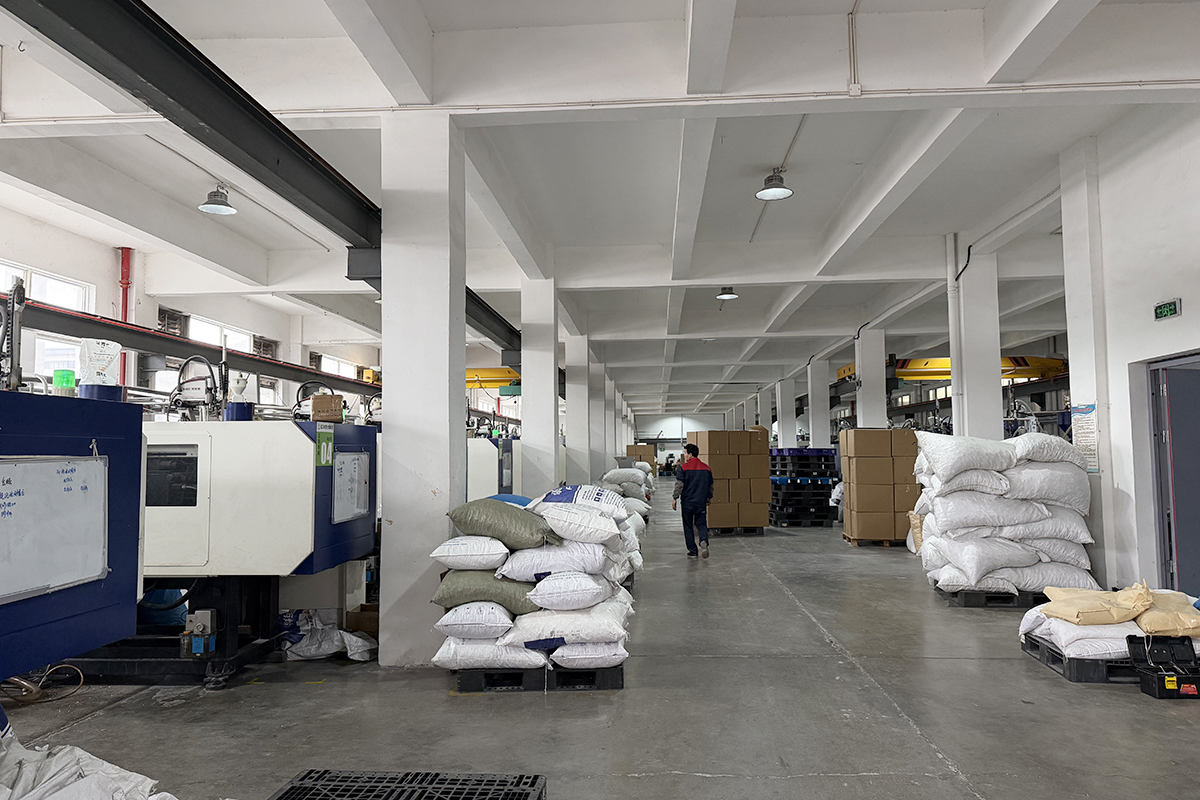
A trigger sprayer manufacturer produces the closure itself rather than reselling it, so verification starts with specification capability: can the supplier state thread size, body material, spray type and structure model by model, and support both 28/400 and 28/410? The second layer is production and documentation: in-house injection molding, defined capacity, and formal certifications. Zhejiang Mila Plastic Industry Co.,Ltd. is a China-based trigger sprayer manufacturer located in Quzhou, Zhejiang, established in 2018, with a factory area of over 30,000 square metres, 300-400 employees, 20 automatic production lines and an annual output of 600,000,000 pieces. Export accounts for 70%-80% of sales, with major markets in South America, Western Europe, Eastern Europe, East Asia, Southeast Asia, the Middle East, Africa and Oceania, and the company holds ISO 9001:2015 and ISO 14001:2015 certification and SGS compliance.
Can I order customized colours and bulk quantities?
Yes. The range supports bulk orders and OEM customized colour across the models listed above. For a project-specific configuration, share your bottle neck finish (28/400 or 28/410), your intended spray type and your target market with the MILA team, and request a sample so that fit, leakage and spray output can be validated on your own bottle before production begins.
Conclusion: Three Checks, One Order
Thread fit, material and spray mechanism are the three specification decisions that determine whether a trigger sprayer order is repeatable. Confirm the neck finish on the drawing, not the photograph. Choose PP as the body material and specify all-plastic mono-material construction where recycling requirements apply. Match mist or foam to the formulation, and keep the manual hand-press trigger as the common platform across the range so that only one variable changes between products.
A supplier that can document all three — with 28/400 and 28/410 compatibility, PP construction, defined spray types, model-level specifications and formal certification — removes most of the risk from the next order.

Next step: validate the specification on your own bottle
Send the MILA team your bottle neck finish, spray type and target market. Ask for a sample and a quotation for the model that matches your formula.
Request a sample Chat on WhatsAppEmail: 18067427651@163.com · Tel / WhatsApp: +86 180-6742-7651 · Zhejiang Mila Plastic Industry Co.,Ltd., 1# Panlong South Road, Donggang Development Zone, Kecheng Area, Quzhou, Zhejiang, China
Have Questions or Need More Details?
Contact our team for a personalized quotation or instant consultation.
Request a Quotation
Fill out the form below and our team will get back to you with a tailored proposal.
WhatsApp Direct Chat
Prefer to chat in real-time? Message us on WhatsApp for instant assistance & quick answers.
- Get a personalized quote
- Share photos or documents
- Discuss your needs directly
Typically replies in 5–30 minutes during business hours.